How many years of work are left
Vault turns your annual expenses, your savings rate and your allocation into a date. The target is your expenses divided by your withdrawal rate, or a number you set yourself. The projection runs from your real net-worth history and your real contributions — not from a figure typed into a calculator once.
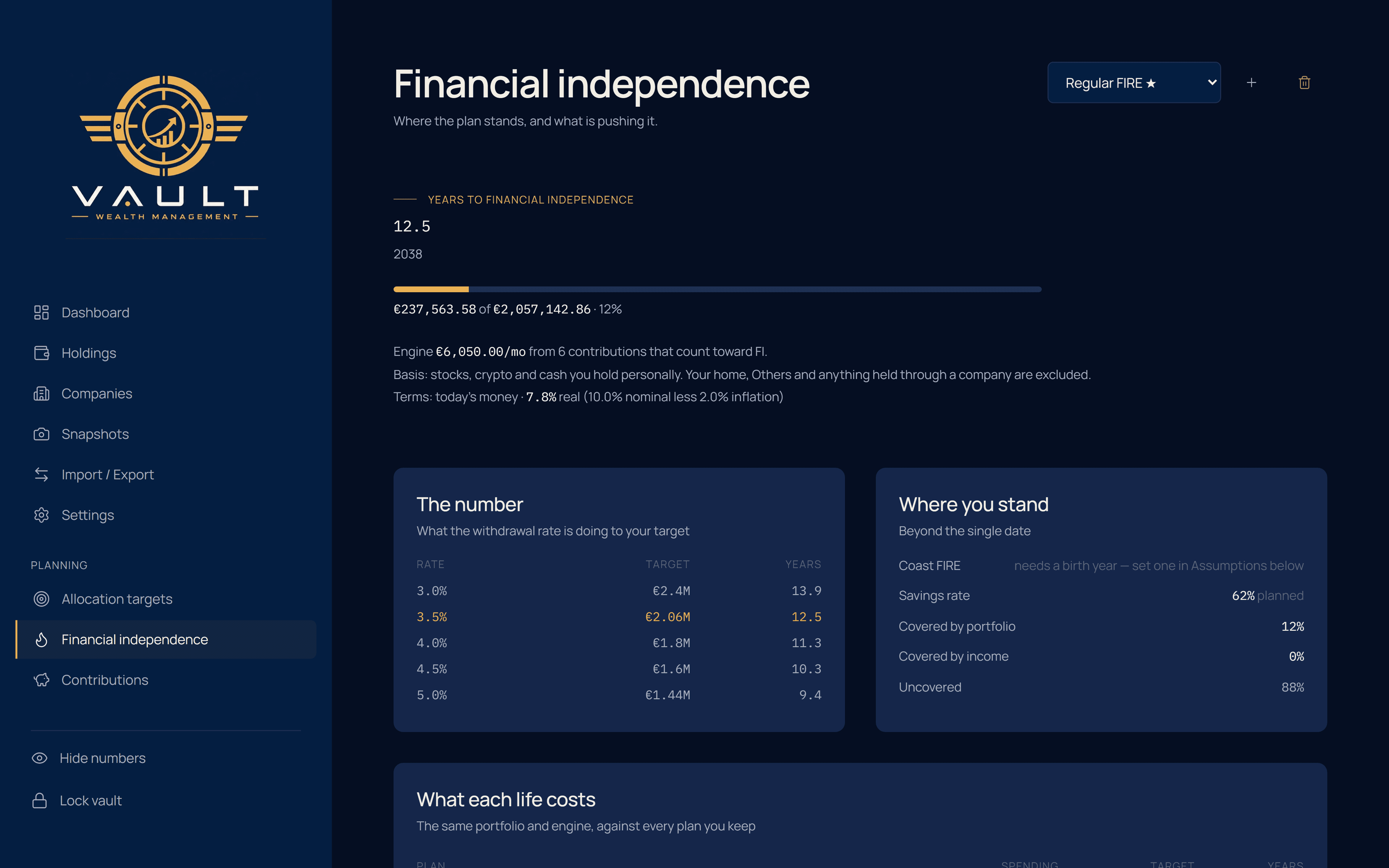
The assumptions are on the screen, not three settings deep
Withdrawal rate, expected return, inflation, effective tax on withdrawals, and the age the plan runs to. All five sit beside the date they produce, and all five are editable where they sit. Change one and watch the date move.
The return comes from your allocation, not from a guess
Set target percentages per asset class and Vault derives the portfolio's expected return and volatility from that mix. Shift ten points from bonds into equities and the projection changes shape immediately — which is what makes an allocation decision visibly a retirement decision.
One date, and the thousand versions of it
A single number hides how much of it is luck. Vault runs a Monte Carlo simulation across a thousand paths and shows the distribution as a fan: the median, the good quartile, and the one where you are still working. Averages flatter. Distributions do not.
What a bad decade would do
Sequence matters more than average return. Vault re-runs the same plan with a poor decade starting now, and again with a poor decade starting the year you stop working — the scenario that ends retirements. You see both dates before you commit to either.
Several plans, side by side
A full stop at a chosen age. Coast, where you stop contributing and let compounding finish the work. Part-time from a chosen year. Keep them all, mark one as your target, and compare what each costs you in years.
What a decision costs, in years
Vault states trade-offs in the only unit that matters. An extra 15,000 a year of spending costs you 4.1 years of work. That sentence, with your own figures in it, is the product.
A projection is arithmetic on assumptions you choose. It is not a forecast, and nothing in Vault is financial advice.