Coins in cold storage, counted without exposing them
A hardware wallet keeps your coins off an exchange. Vault keeps the figure off our servers in any readable form: you enter a quantity, we price it from public market data, and the value is encrypted in your browser under a key we never receive. Nothing in Vault needs to know which addresses hold the coins, because it prices an amount rather than an account.
You have done this before
Vault's recovery phrase is twelve BIP-39 words, generated in your browser, shown once, and never stored or transmitted. If you have set up a hardware wallet, this is the same ritual for the same reason: the phrase is what makes the data yours alone, and the price of that is that nobody — including us — can recover it for you. You already accepted this trade for your coins. This is the same trade, applied to the ledger that counts them.
No address, no xpub, no API key — because none is useful here
Vault never asks where your coins live, and the reason is duller than a privacy stance: it has no use for the information. The product needs a quantity and a ticker to compute a value. An address would tell it nothing it needs and would create a record neither of us has a reason to hold. So there is no field for one, and nothing degrades if you never offer it.
What Vault still knows
Being straight about the limit is the point of the rest. Your account has an email address on it, and record types and dates are stored in plaintext so the database can function. That means Vault knows an account holds crypto and knows when the figure last changed. It does not know the quantity, the coin, or the value — those are ciphertext. If that distinction matters to you, and it should, the full list is written out on its own page.
Unlock with a passkey instead of twelve words
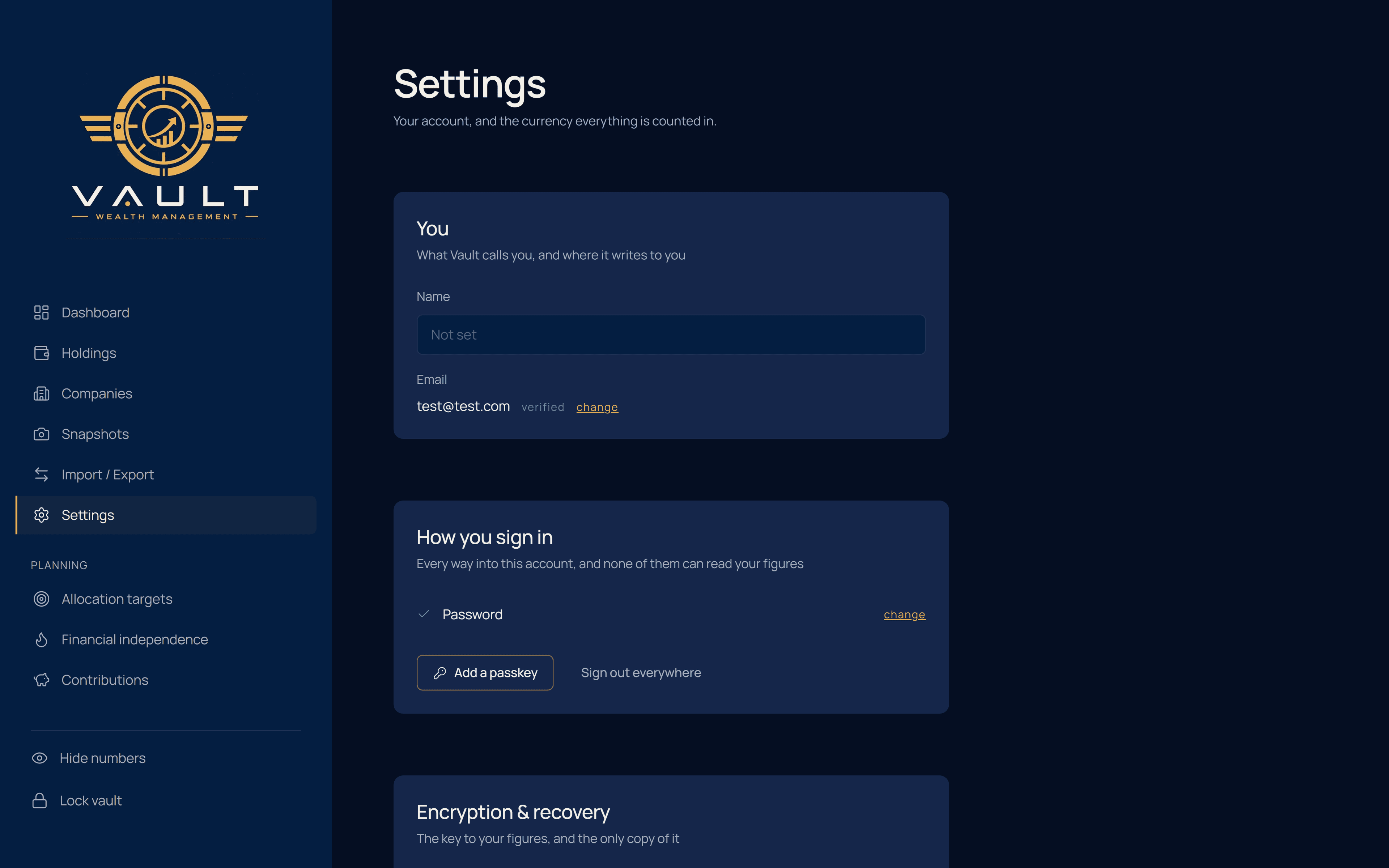
Typing a phrase every time a tab closes is how people stop using a product. Vault can wrap a second copy of your key under a secret your authenticator derives during an ordinary passkey check — Touch ID, Windows Hello, a security key. Enrolment happens only from an already-unlocked vault, and where a browser cannot do it, the phrase still works and nothing errors.
Check the phrase before you need it
A recovery phrase is written down once, at the most stressful minute of setup, and not looked at again for a year. Settings has a check that asks for all twelve words and performs a real unwrap with them. It asks for twelve rather than three because the app never stored the phrase — the only honest test of a phrase is whether it works.
And then the rest of the balance sheet
The point of counting cold storage here rather than in a crypto app is what sits beside it: the flat and its mortgage, the brokerage account, the pension, the company you own part of, the cash in three currencies. One figure, in the currency you count in, and a projection of how many years of work are left. That is the thing no wallet and no chain explorer will ever tell you.