Know what you're worth. Know when you're free.
Vault brings your entire financial life into one private balance sheet — then projects the path to financial independence.
Free for fifteen holdings. Pro is $15 a month, and free until launch.
Your financial life is spread across places.
A broker here. A pension there. A wallet you check separately. A flat with a mortgage against it. Cash in two currencies. Maybe a company that holds some of it. Each one tells you about itself. None of them tells you where you stand.
Vault puts all of it on one ledger, in one currency, as one figure you can actually trust.
One exact picture
Investments, property, crypto, cash, debt and company ownership, consolidated into the currency you count in.
A date, not a feeling
Years to financial independence, computed from your own allocation, spending and withdrawal rate — with every assumption visible beside the number it drives.
Private by construction
Your figures are encrypted in your browser before they are sent. No bank login is requested, because nothing in Vault needs one.
The number is the interface.
Vault opens on what you are worth, what it is made of, and where it lives. Not a feed, not a score, not a set of tiles you have to assemble into an answer.
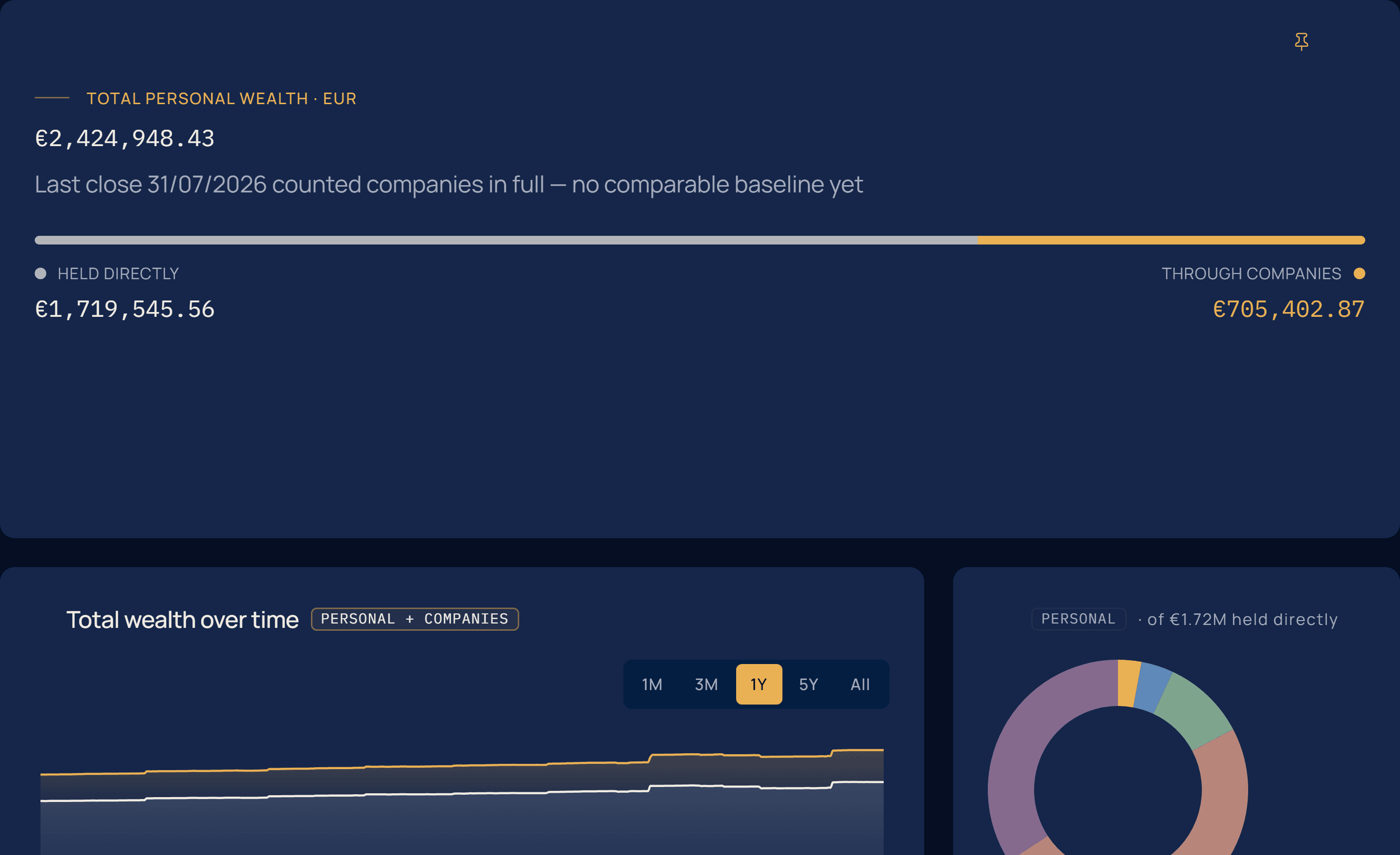
Your entire financial life. One balance sheet.
Stocks. ETFs. Bonds. Crypto. Property with the mortgage against it. Cash. Debt. Company ownership. Vault holds them on one ledger so your net worth is a number rather than an estimate.
- Stocks, ETFs and bonds
- $431,200 · 28.2%
- Property, at market value
- $640,000 · 41.9%
- Companies you own a share of
- $212,400 · 13.9%
- Crypto
- $118,650 · 7.8%
- Cash, across currencies
- $96,200 · 6.3%
- Everything that fits no category
- $28,457 · 1.9%
- Total assets
- $1,526,907
- Mortgage and other debt
- -$242,000
- Net worth
- $1,284,907+2.4% this month · +$30,118
Sample data. Every figure shown is invented.
Four steps, then a few minutes a month.
Add what you own
Type it, paste a spreadsheet, or drop a PDF statement and let Vault read it in the browser, without the file being uploaded. Anything with a ticker prices itself from that point on.
See it consolidated
Five asset classes, any currency, any region, converted into your base currency with rates refreshed through the day.
Close the month
One snapshot a month builds your net-worth history and derives your savings rate from what actually changed. No transaction import.
Read the projection
Years to financial independence, the target that implies, and what a bad first decade would do to the date.
Import your wealth without uploading it.
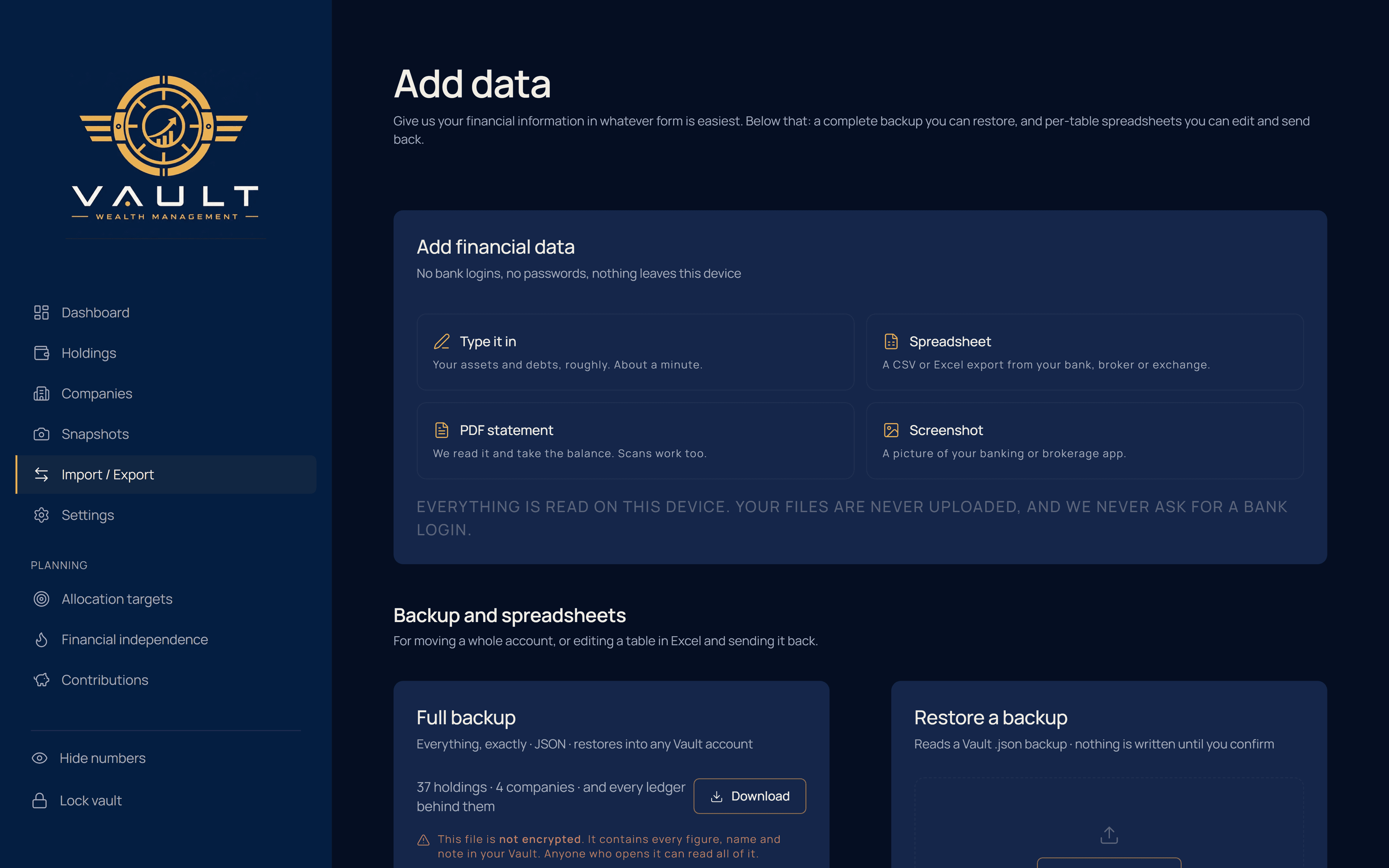
A CSV, an Excel file, a broker PDF, a screenshot of a portfolio. Vault reads the file in your browser and never sends it anywhere.
From a spreadsheet
Paste it or drop it. Vault maps the columns — name, value, currency, ticker — and shows you the mapping before anything is written.
From a statement
A broker PDF, a scanned page, a screenshot. Rows are extracted on your machine, into a review table you correct first.
By hand, quickly
Name, class, currency, value, and a ticker if it has one. Thirty seconds, and the position prices itself from then on.
File import is part of Pro — free until launch for anyone joining now. Typing a holding, and restoring a backup, are free on every plan.
A spreadsheet can do almost anything.
Vault does this without making you maintain it.
| Spreadsheet | Vault |
|---|---|
| You build the model | The structure is already there |
| You update prices by hand | Prices refresh from public markets |
| History depends on your discipline | Snapshots are a feature, not a habit |
| FIRE formulas are yours to write and debug | The projection engine is built in |
| Assumptions drift between tabs | Assumptions sit beside the result they drive |
| Property, companies and crypto each need their own sheet | One ledger, five asset classes |
| Security is whatever your storage does | Encrypted in your browser before it is stored |
The spreadsheet was never the problem. Keeping it correct was.
And the apps that connect to your accounts.
Where Vault differs from wealth software built around access to your data.
| Vault | Wealth apps that connect to your accounts | |
|---|---|---|
| Full net worth, one currency | Yes | Yes |
| Property with its mortgage | Yes, with the schedule | Usually a value you type |
| Companies, resolved to your share | Yes, through nesting | Rarely a documented feature |
| Financial-independence projection | Built in, with Monte Carlo | On a paid tier where offered |
| Bank credentials | None asked for | Required for the connection |
| What their server can read | Ciphertext, identifiers, dates | Your balances |
| Upkeep each month | A few minutes | Close to none where a connector exists |
When can you stop working?
Move any assumption and the date moves with it. This is the same arithmetic the product runs, in the same code.
Your annual spending divided by the withdrawal rate — not a fixed multiple of 25.
Nothing you type here is sent anywhere. It is computed in your browser and forgotten when you leave.
A projection is arithmetic on assumptions you choose. It is not a forecast, and it is not advice.
Want this calculation based on what you actually own?
A balance sheet we cannot read.
Most wealth software is built around access to your financial data. Vault is built the other way. We do not need your bank credentials, and we never ask for them.
Every figure is encrypted in your browser before it is sent, under a key wrapped by a twelve-word phrase we never receive. What reaches the server is ciphertext, a row identifier and a date.
Vault cannot show you your own net worth without your phrase or your passkey. That is what makes this structural rather than a policy we could quietly change.
We can see that a record exists and when it changed. Never what it is worth.
Because the ciphertext is held for you, your vault opens on any device where you unlock it. There is no file to carry between machines.
Privacy mode masks every figure on every screen and stays on until you turn it off, so the app is safe to open on a train.
- USD / EUR
- 0.8569
- USD / GBP
- 0.7331
- USD / CHF
- 0.8022
No account, no login, no identifier on the request.
- Live rates, fetched for this page. With no account, no login and no identifier on the request. The figures above this line arrived when the page was built.
- When a price is stale, Vault says so. It shows the last known good value and the time it was taken, rather than a confident wrong number.
- Assumptions are always on screen. Every projection shows the return, inflation and withdrawal rate that produced it.
- Snapshots are exact. A monthly close is a record, not a smoothed line.
Your financial life, kept in one place.
Start free. The full instrument is $15 a month.
Free
Up to fifteen holdings, consolidated into one exact figure.
- Every asset class — property with its mortgage, companies, crypto
- Prices refreshed from public markets
- Monthly snapshots and net-worth history
- Full export, whenever you want it
- The same privacy architecture, unchanged
Pro
Early access — free until launch.
No limit on holdings, and the date you are working toward.
- Everything in Free, with no limit on holdings
- Years to financial independence — the projection engine
- Coast FIRE, Monte Carlo and the sequence-of-returns test
- Import from spreadsheets, Excel and PDF statements
- No ads.
- No selling your financial data.
- No bank credentials required, on any plan.
- The privacy architecture is not a paid feature. Free vaults are encrypted exactly the same way.
Open a vault during early access and Pro is yours at no charge until launch — the whole instrument, not the free tier — and you keep it free for a year after that. Free stays free either way, and you will always see the price before anything is charged.
No card, and nothing to cancel.
Someone has to pay for this, and it should be you.
A net-worth app is paid for by its users or by someone who wants their data. There is no third option. Vault takes the subscription, and that is exactly what makes it possible to refuse the bank connection: nothing downstream needs your transactions, so nothing asks for them.
Questions about Vault
Does Vault connect to my bank?
No, and it never will as a requirement. Prices for listed assets come from public markets. Everything else you enter. There are no credentials to store and none to lose.
Can you see my net worth?
No. Values are encrypted in your browser before they are sent, under a key we never receive. The server holds ciphertext, identifiers and dates.
What if I lose my recovery phrase?
Your figures cannot be recovered by anyone, including us. You can sign in and reset the vault, which clears the unreadable data and keeps your account. Settings has a check that proves your phrase still works, before you need it to.
Do I have to type my crypto in by hand?
You enter a quantity once. The price is then Vault's job, from public exchange data refreshed through the day. So it is manual entry, not manual maintenance. And typing a number in is not itself what keeps it private — plenty of trackers offer manual entry and store the result in the clear, beside the email address that identifies you. What makes it private here is that the figure is encrypted before it leaves your browser.
Why won't Vault connect to my wallet or exchange?
Because it has no use for the connection. Vault prices a quantity of an asset, not an account, so a wallet address or an API key would tell it nothing it needs and would create a record neither of us has a reason to hold.
Can I track property?
Yes. Each property carries its own loan, amortisation and events, so equity is a figure you read rather than one you compute.
Can I track companies I own?
Yes. Hold assets inside a company, or a company inside a company, and see your share of what each one holds.
Is Vault a budgeting app?
No. Vault is a consolidated net-worth and financial-independence system. It will tell you your savings rate from what actually changed month to month, but it does not categorise your spending and does not want your transactions.
What are the FIRE assumptions?
Expected return, inflation and withdrawal rate — all editable, all shown next to the result they produce. Behind the single date there is also a Monte Carlo distribution and a sequence-of-returns test.
How long does it take to keep up to date?
Listed positions update themselves. For everything else, most people spend a few minutes once a month, at the same time they close the snapshot.
There is a free tier. Why would I pay $15 a month?
The free plan holds up to fifteen holdings and consolidates them into one exact figure — a real balance sheet, not a trial with a timer on it. Pro buys three things: no limit on holdings, the financial-independence projection, and import from spreadsheets and PDF statements. Free tells you what you are worth; Pro tells you when you can stop working. Right now you would not pay anything for it: a vault opened during early access gets Pro free until launch, and for a year after that.
Is the free version less private?
No. The encryption is the architecture, not a feature. Every vault is encrypted in your browser under a key we never receive, on every plan, including the free one.
Can I cancel?
At any time, with no notice period. Export stays available whatever your plan, and a lapsed subscription becomes a limited account rather than a closed one — your data is not held hostage to a renewal.
Your balance sheet, on your side of the encryption.